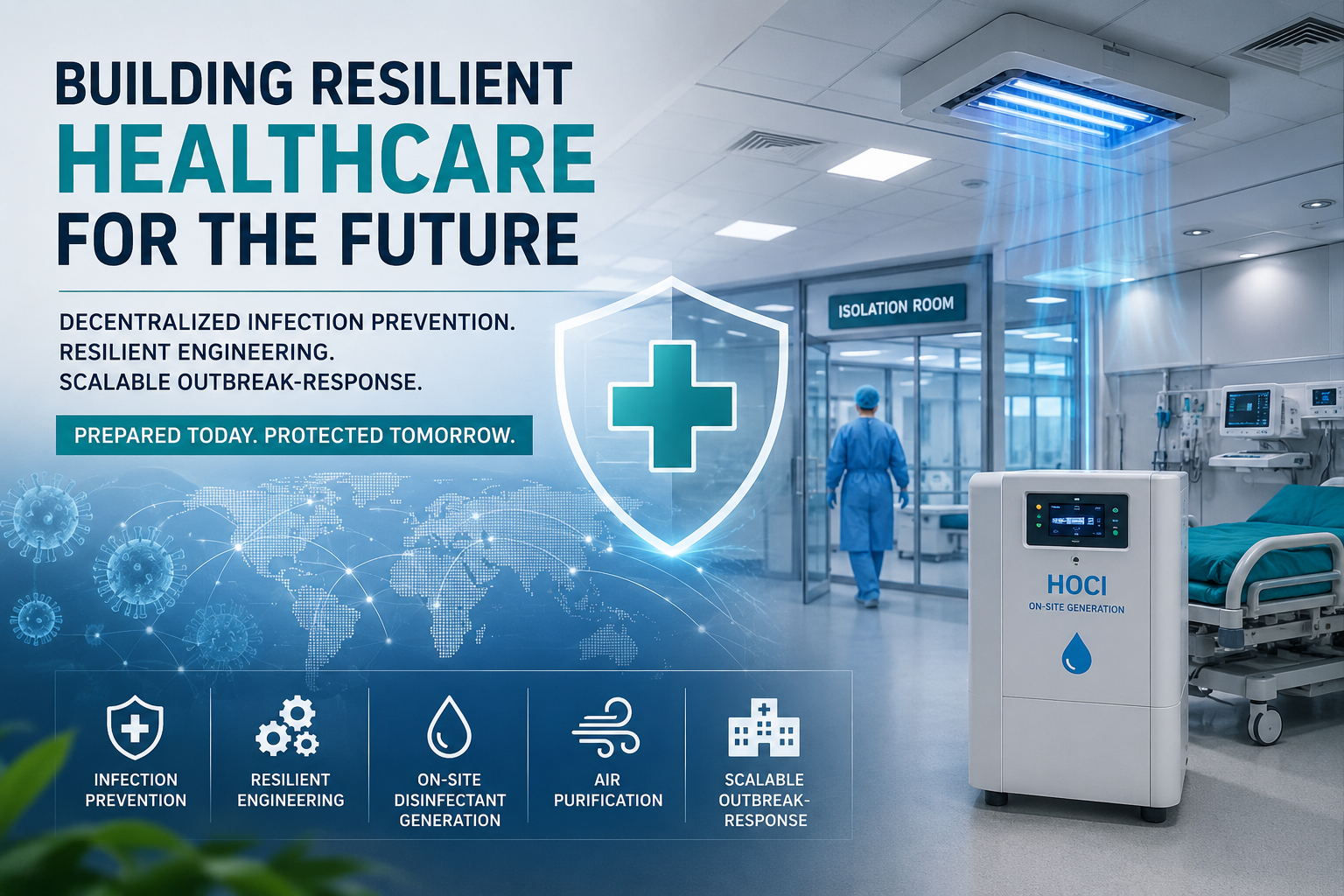
When the Next Outbreak Arrives, Will Your Hospital Be Ready?
Decentralized Infection Prevention and Healthcare Resilience: Building Future-Ready Pandemic Infrastructure
IPC, Healthcare Resilience Series: Infection Control · Biodefense · Engineering Infrastructure · Public Health Strategy
The COVID-19 pandemic exposed the fragility of centralized healthcare systems, highlighting the urgent need for decentralized infection prevention, resilient healthcare engineering, and scalable outbreak-response infrastructure.
The Lesson COVID-19 Left Unlearned
In early 2020, hospitals worldwide faced unprecedented challenges: overwhelming patient surges, PPE shortages, rationed disinfectants, oxygen bottlenecks, and alarming healthcare worker infections.
COVID-19 revealed that pandemics are not merely pathogen crises—they are systems failures. Centralized supply chains broke down, logistics networks collapsed, and ordinary healthcare infrastructure proved incapable of adapting to extraordinary biological emergencies.
“Preparedness built during peace determines survival during crisis.”
The Fragility of Centralized Preparedness
Modern healthcare systems prioritize efficiency through just-in-time inventory, global manufacturing, and centralized logistics. While cost-effective under normal conditions, these models are structurally brittle during pandemics.
- Global PPE shortages disrupted hospital operations within 72 hours.
- Nearly 190 countries competed simultaneously for critical supplies.
- Airborne pathogens spread 3x faster in unengineered indoor spaces.
Future biological emergencies may include higher transmissibility, faster international spread, and supply chain disruptions worsened by geopolitical instability.
“The next outbreak may not wait for supply chains to recover.”
Why Governments Are Increasing Biodefense Investments
Nations are rapidly strengthening biodefense systems through strategic preparedness agencies, genomic surveillance, wastewater epidemiology, vaccine platforms, and emergency stockpiles.
Governments increasingly recognize that biological preparedness must include not only surveillance and vaccines, but also operational healthcare continuity.
“Preparedness is no longer only about vaccines and surveillance — it is also about operational continuity.”
Engineering Controls: The Future of Healthcare Preparedness
Engineering controls are among the highest-impact yet underfunded pandemic preparedness investments.
- Air purification: HEPA and UV-C systems continuously reduce airborne pathogen loads.
- Onsite disinfectant generation: HOCl systems create broad-spectrum disinfectants from water, salt, and electricity.
- Negative pressure retrofits: Standard rooms can rapidly convert into safer isolation units.
- Modular surge infrastructure: Expandable units provide scalable outbreak-response capacity.
“Engineering controls can buy critical time when healthcare systems are under pressure.”
Onsite Disinfectant Generation: Supply Chain Independence
Hypochlorous acid (HOCl) systems provide decentralized disinfectant production, reducing dependence on fragile external logistics.
Benefits include:
- Continuous disinfectant availability during crises
- WHO-recognized efficacy
- Biodegradability and safety for occupied healthcare spaces
- Reduced costs and logistics vulnerabilities
“Decentralized infection prevention may become as important as decentralized energy.”
Air Purification and Rapid Isolation Strategies
Airborne pathogen transmission requires hospitals to rethink environmental infection prevention.
Portable HEPA filtration, UV-C systems, and rapid negative-pressure conversion protocols can transform healthcare environments without large-scale renovations.
“Future-ready hospitals are defined not only by beds, but by adaptability.”
Fuel Shortages and Compound Crisis Preparedness
Healthcare systems remain deeply dependent on petroleum-based logistics. Biological emergencies combined with fuel shortages or geopolitical disruptions create dangerous compound crises.
Preparedness must include:
- Distributed oxygen generation
- Local PPE manufacturing
- Regional supply stockpiles
- Operational continuity planning
“Healthcare resilience now depends as much on infrastructure engineering as on clinical medicine.”
India’s Role as a Global Preparedness Innovation Model
India’s frugal innovation ecosystem offers scalable solutions for global pandemic preparedness.
- Rapid domestic PPE manufacturing expansion
- Affordable oxygen generation plants
- Portable air purification systems
- Indigenous HOCl generation technologies
“India is not only a healthcare market — it is a potential global innovation hub for affordable outbreak-response technologies.”
Building Future-Ready Hospitals
Hospital preparedness should be measured by resilience, not bed count alone.
- Surge-ready ward designs
- Onsite disinfectant and oxygen production
- Rapid room conversion capabilities
- Air quality infrastructure
- Healthcare worker protection engineering
“Healthcare worker protection is the foundation of sustained outbreak response.”
Practical Recommendations for Healthcare Leaders
For Hospitals
- Conduct infrastructure vulnerability audits
- Invest in onsite disinfectant generation
- Deploy portable air purification systems
- Establish rapid isolation conversion protocols
- Strengthen local manufacturing partnerships
For Policymakers
- Integrate engineering controls into national standards
- Support district and rural healthcare resilience
- Fund indigenous biomedical innovation
- Plan for compound logistics disruptions
The Window for Preparedness Is Open
Biological emergencies are inevitable. The time between crises is the only opportunity to build decentralized, resilient healthcare systems before they are tested.
Pandemic preparedness is now essential national infrastructure, as critical as energy, food, or water security.
“Preparedness is no longer optional. It is essential infrastructure.”
Leave a Reply